Rigin 200mg (Palmitoyl Tetrapeptide-7) (Topical)
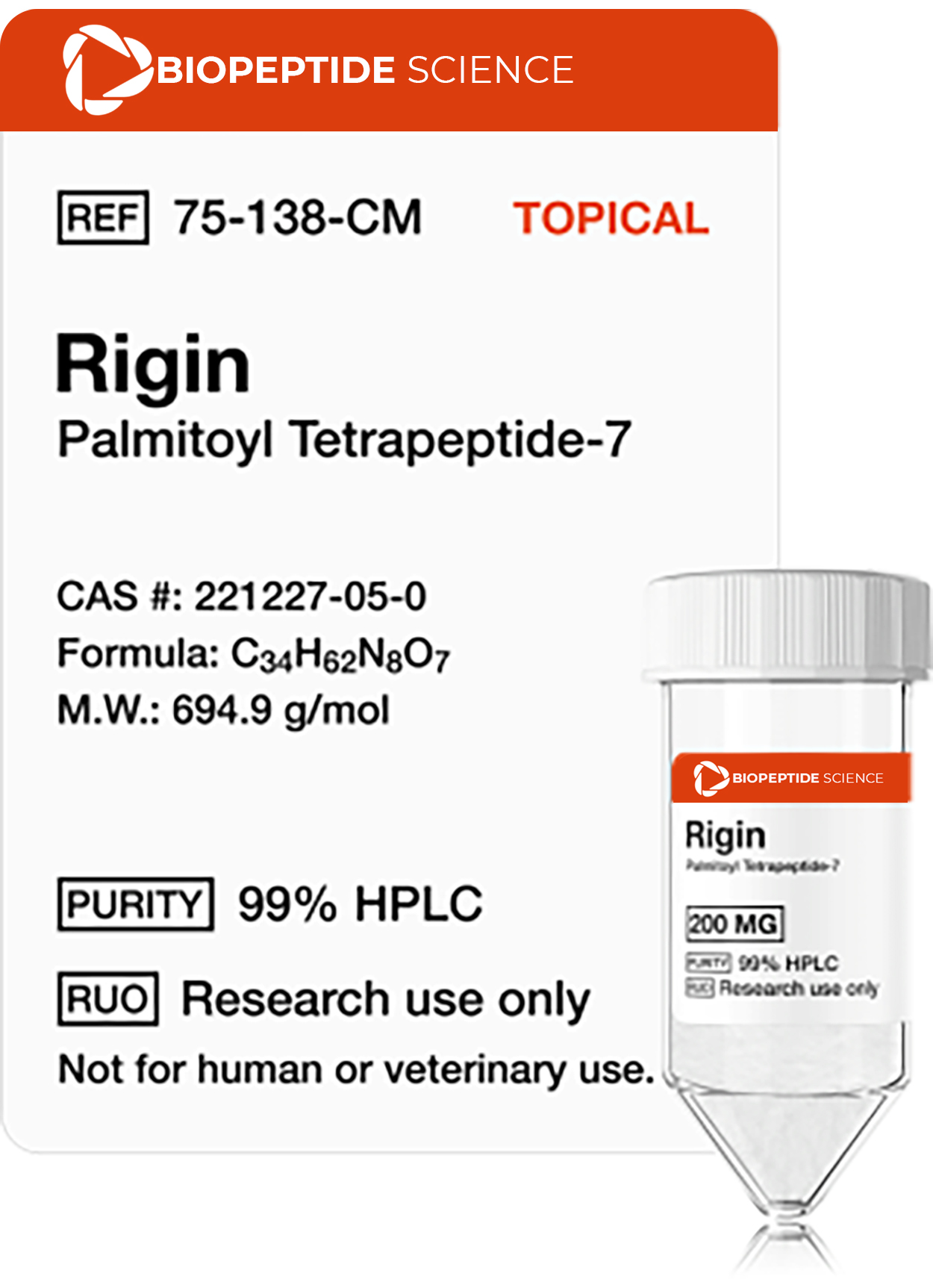
Rigin 200mg (Palmitoyl Tetrapeptide-7)
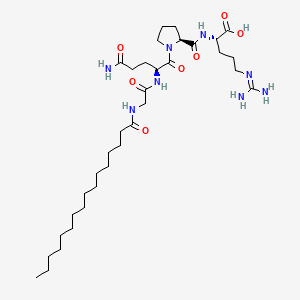
Rigin is a name that can be applied to a compound in which a fragment of immunoglobulin G (IgG) has been attached to a fatty acid residue (palmitoyl in this case). It can also strictly refer to the IgG fragment alone [1]. In this article, the term refers to the full palmitoyl-Gly-Gln-Pro-Arg molecule and not to the peptide alone. Rigin is of scientific interest for its ability to boost elasticity and firmness of skin. It can also improve skin hydration and smoothness by controlling the secretion of cytokines.
Sequence (Three-Letter Code): palmitoyl-Gly-Gln-Pro-Arg-OH (Pal-GQPR)
Molecular formula: C34H62N8O7
Molecular Formula (Peptide Only): C18H32N8O6
Molecular weight: 694.9 g/mol
Synonyms: 221227-05-0, Palmitoyl tetrapeptide-7, N-Palmitoylrigin, Palmitoyl-GQPR, UNII-Q41S464P1R
Research Application:
Rigin was originally developed as a potential immunostimulatory and neurotrophic (can regrow nervous tissue) peptide. It is still under active investigation for its ability to encourage nerve healing, particularly after burns and tissue grafts [2].
Recently, interest in rigin has increased among researchers involved in trying to understand how extracellular matrix (ECM) growth is modulated. Rigin is being investigated in animal models for its ability to influence collagen and elastin synthesis in the ECM and thus for its ability to improve skin elasticity and firmness [3].
What Is Rigin?
The rigin peptide is a fragment of the IgG antibody found in many mammals (amino acids 341-344 of human IgG H-chain). It was originally developed after a different tetrapeptide, tuftsin, was discovered to have immunostimulatory and neurotrophic activities [2].
The way in which rigin is used can be confusing because sometimes the term “rigin” is used to refer only to a peptide and sometimes to the same peptide with palmitoyl attached. “Rigin peptide” may be a more accurate name for the IgG fragment alone, but the word rigin can legitimately refer to both entities, so take care when discussing. Rigin may also be referred to as palmitoyl tetrapeptide-7 or simply as palmitoyl tetrapeptide.
What Does Rigin Do?
Rigin, it turns out, is capable of modulating the production of interleukin-6 (IL-6), a signaling molecule made by T-cells. IL-6 recruits additional immune cells to the site of injury or infection. Sometimes, however, the immune response can become too large and may damage healthy tissue. In the case of skin, this can lead to damage to the ECM and thus breakdown of collagen and elastin. By counteracting the effects of IL-6, rigin is able to reduce the effects of an immune response and protect the skin from damage.
Rigin has also been shown, in animal models, to have activity against matrix metalloproteinases (MMPs). MMPs are a group of enzymes involved in the breakdown of ECM proteins during normal tissue growth. By downregulating the activity of MMPs, rigin can reduce ECM damage and allow cells that restore and maintain the ECM to keep up with the effects of aging [4]. The action of rigin is similar, in some ways, to dehydroepiandosterone, which is sometimes referred to as the “youth hormone.”
Where to buy Rigin 200mg (Palmitoyl Tetrapeptide-7) (Topical)
Rigin Research on Reducing Skin Damage?
Based on observations from animal research and from studies on human skin cells grown in a laboratory setting, rigin can reduce the effects of aging on the skin. This means reducing the appearance of fine lines and wrinkles as well as evening out skin tone, improving elasticity, and increasing skin hydration. Rigin is often combined with other ingredients, such as palmitoyl oligopeptide, to create a synergistic effect that boosts skin rejuvenation [5].
IGF-1 LR3 (Qualité Récepteur) 1 mg
L’IGF-1 LR3 de qualité « Récepteur » est un réactif de recherche de premier choix, destiné aux études sur la croissance cellulaire, les récepteurs de l’IGF et les protéines de liaison de l’IGF. Il s’avère plus puissant *in vitro* que l’rH IGF-1 et l’IGF-1 LR3 de qualité « Milieu » (Media Grade), en raison d’une augmentation drastique de son activité biologique (affinité plus forte pour le récepteur de l’IGF). C’est précisément cette activité biologique accrue qui distingue l’IGF-1 LR3 de qualité « Récepteur » de l’IGF-1 LR3 de qualité « Milieu » (standard). L’IGF-1 LR3 de qualité « Milieu » est plus couramment utilisé dans la culture cellulaire commerciale (par opposition aux cultures de cellules de mammifères) ; il peut également servir de réactif de recherche à moindre coût pour faciliter les études où la puissance biologique revêt une importance secondaire. Pour maximiser les résultats lors d’études cellulaires *in vitro* impliquant des cellules d’origine animale ou lors de processus de production, il est impératif d’utiliser exclusivement l’IGF-1 LR3 de qualité « Récepteur ». La supplémentation des cultures de cellules de mammifères avec le Long R3 IGF-1 — même à une concentration nettement inférieure — se traduit par une productivité bien plus élevée que celle obtenue avec les concentrations standard d’insuline et/ou d’IGF-1 standard. L’IGF-1 LR3 est mieux à même de stimuler le récepteur de type 1 de l’IGF, induisant ainsi un niveau supérieur de signalisation intracellulaire, de prolifération cellulaire et d’inhibition de l’apoptose.
Rigin 200mg (Palmitoyl Tetrapeptide-7) (Topical)
L’IGF-1 LR3 de qualité « Récepteur » présente une activité biologique supérieure à celle de l’IGF-1 LR3 standard, et ce, *in vitro*. Par conséquent, l’IGF-1 LR3 de qualité « Récepteur » permet d’obtenir des résultats supérieurs à ceux de l’IGF-1 LR3 standard.
IGF-1 LR3, Qualité Récepteur
IGF-1 LR3 de qualité « Récepteur »
Séquence : MFPAMP LSSLF VNGPR TLCGA ELVDA LQFVC GDRGF YFNKP TGYGS SSRRA PQTGIV DECCFR SCDLRR LEMY CAPLK PAKSA
Masse molaire : 9 111 Da
Synonymes : Long Arg3 IGF-1 (Qualité Récepteur)
Long R3 IGF-1, Qualité Récepteur
La liaison aux IGFBP et l’activité biologique accrue du Long R3 IGF-1
En résistant à la liaison avec les IGFBP (protéines de liaison de l’IGF), l’IGF-1 LR3 exerce un effet plus marqué que l’IGF-1 standard. Sa durée d’action prolongée permet d’utiliser des quantités moindres pour obtenir des effets équivalents. Certains dérivés de l’IGF-1, tels que le dérivé GPE — composé uniquement des trois derniers acides aminés N-terminaux de la protéine IGF-1 — se sont révélés avoir des effets thérapeutiques dans le cadre de lésions neurologiques, comme l’accident vasculaire cérébral (AVC). La plupart des études portant sur les effets des dérivés de l’IGF-1 ont été menées sur des modèles animaux non humains ou par le biais de cultures cellulaires.
Rigin 200mg (Palmitoyl Tetrapeptide-7) (Topical)
Interactions avec les récepteurs du facteur de croissance analogue à l’insuline (IGF)
L’IGF-1 se lie à au moins deux récepteurs situés à la surface des cellules : l’IGF-1R et le récepteur de l’insuline. Le récepteur de l’IGF-1 est qualifié de récepteur « physiologique », car l’IGF-1 s’y fixe avec une affinité nettement supérieure (environ 100 fois plus élevée) que sur le récepteur de l’insuline. En se liant à l’IGF-1R, l’IGF-1 peut influencer le métabolisme, la croissance cellulaire (hypertrophie), la différenciation et la division cellulaire (hyperplasie), la prévention de la mort cellulaire (apoptose), le développement normal, et même la croissance tumorale maligne. L’IGF-1R a été impliqué dans plusieurs types de cancers différents, notamment ceux du sein, de la prostate et du poumon. L’IGF-1 se lie également au récepteur de l’insuline et l’active, favorisant ainsi la captation du glucose sanguin par les cellules. Les effets de l’IGF-1 sur les cellules musculaires sont de trois ordres. Premièrement, l’IGF-1 favorise l’hyperplasie, c’est-à-dire l’augmentation du nombre de cellules musculaires. Deuxièmement, l’IGF-1 exerce un effet marqué sur le muscle squelettique, notamment en ce qui concerne la durée de vie des cellules satellites. Les cellules satellites soutiennent les cellules musculaires en leur fournissant les nutriments nécessaires et en contribuant à leur fonctionnement efficace. En prolongeant la durée de vie de ces cellules, l’IGF-1 contribue à accroître leur nombre au sein du tissu musculaire. Enfin, l’IGF-1 stimule la différenciation des myoblastes ; autrement dit, il favorise la transformation de la descendance des cellules souches — issues de cellules souches pluripotentes non spécifiques — en tissu musculaire spécialisé. De cette manière, l’IGF-1 accélère le développement musculaire en augmentant le rythme auquel les cellules souches génériques sont converties en cellules musculaires.
Rigin 200mg (Palmitoyl Tetrapeptide-7) (Topical)
TOUS LES ARTICLES ET INFORMATIONS SUR LES PRODUITS PRÉSENTÉS SUR CE SITE WEB SONT FOURNIS À DES FINS STRICTEMENT INFORMATIVES ET ÉDUCATIVES.
Les produits proposés sur ce site web sont destinés exclusivement aux études *in vitro*. Les études *in vitro* (du latin *in vitro*, signifiant « dans le verre ») sont réalisées en dehors de l’organisme vivant. Ces produits ne sont ni des médicaments ni des substances pharmaceutiques, et n’ont pas été approuvés par la FDA pour prévenir, traiter ou guérir une quelconque affection médicale, un trouble ou une maladie. Toute introduction corporelle, de quelque nature que ce soit, chez l’être humain ou l’animal est strictement interdite par la loi.
How to order Rigin 200mg (Palmitoyl Tetrapeptide-7) (Topical)
Rigin ist die Bezeichnung für eine Verbindung, bei der ein Fragment von Immunglobulin G (IgG) an einen Fettsäurerest (in diesem Fall Palmitoyl) gebunden ist. Der Begriff kann sich auch ausschließlich auf das IgG-Fragment beziehen [1]. In diesem Artikel bezeichnet Rigin das vollständige Palmitoyl-Gly-Gln-Pro-Arg-Molekül und nicht das Peptid allein. Rigin ist aufgrund seiner Fähigkeit, die Elastizität und Festigkeit der Haut zu verbessern, von wissenschaftlichem Interesse. Es kann außerdem die Hautfeuchtigkeit und -glätte durch die Regulierung der Zytokinsekretion verbessern.
Sequenz (Drei-Buchstaben-Code): Palmitoyl-Gly-Gln-Pro-Arg-OH (Pal-GQPR)
Summenformel: C34H62N8O7
Summenformel (nur Peptid): C18H32N8O6
Molekulargewicht: 694,9 g/mol
Synonyme: 221227-05-0, Palmitoyl-Tetrapeptid-7, N-Palmitoylrigin, Palmitoyl-GQPR, UNII-Q41S464P1R
Rigin 200 mg (Palmitoyl-Tetrapeptid-7) (topisch) kaufen
Anwendung in der Forschung:
Rigin wurde ursprünglich als potenziell immunstimulierendes und neurotrophes Peptid (das Nervengewebe regenerieren kann) entwickelt. Seine Fähigkeit, die Nervenheilung zu fördern, insbesondere nach Verbrennungen und Gewebetransplantationen, wird weiterhin intensiv untersucht [2].
In letzter Zeit ist das Interesse an Rigin bei Forschern, die die Modulation des Wachstums der extrazellulären Matrix (ECM) untersuchen, gestiegen. Rigin wird in Tiermodellen hinsichtlich seiner Fähigkeit erforscht, die Kollagen- und Elastinsynthese in der ECM zu beeinflussen und somit die Hautelastizität und -festigkeit zu verbessern [3].
Was ist Rigin?
Das Rigin-Peptid ist ein Fragment des IgG-Antikörpers, der in vielen Säugetieren vorkommt (Aminosäuren 341–344 der humanen IgG-H-Kette). Es wurde ursprünglich entwickelt, nachdem bei einem anderen Tetrapeptid, Tuftsin, immunstimulierende und neurotrophe Eigenschaften entdeckt wurden [2].
Die Verwendung des Begriffs „Rigin“ kann verwirrend sein, da er manchmal nur für das Peptid und manchmal für dasselbe Peptid mit angehängtem Palmitoyl verwendet wird. „Rigin-Peptid“ ist möglicherweise die präzisere Bezeichnung für das IgG-Fragment allein, aber der Begriff „Rigin“ kann beides bezeichnen. Daher ist bei der Verwendung Vorsicht geboten. Rigin wird auch als Palmitoyl-Tetrapeptid-7 oder einfach als Palmitoyl-Tetrapeptid bezeichnet.
Was bewirkt Rigin?
Rigin kann die Produktion von Interleukin-6 (IL-6), einem von T-Zellen gebildeten Signalmolekül, modulieren. IL-6 rekrutiert zusätzliche Immunzellen zum Ort einer Verletzung oder Infektion. Manchmal kann die Immunantwort jedoch überschießend ausfallen und gesundes Gewebe schädigen. Bei der Haut kann dies zu Schäden an der extrazellulären Matrix (ECM) und damit zum Abbau von Kollagen und Elastin führen. Indem Rigin den Wirkungen von IL-6 entgegenwirkt, kann es die Auswirkungen einer Immunantwort reduzieren und die Haut vor Schäden schützen.
In Tiermodellen zeigte Rigin zudem Aktivität gegen Matrix-Metalloproteinasen (MMPs). MMPs sind eine Gruppe von Enzymen, die am Abbau von ECM-Proteinen während des normalen Gewebewachstums beteiligt sind. Durch die Herabregulierung der MMP-Aktivität kann Rigin Schäden an der extrazellulären Matrix (ECM) reduzieren und Zellen, die die ECM wiederherstellen und erhalten, dabei unterstützen, den Zeichen der Hautalterung entgegenzuwirken [4]. Die Wirkung von Rigin ähnelt in mancher Hinsicht der von Dehydroepiandrosteron (DHEA), das auch als „Jugendhormon“ bezeichnet wird.
Wo kann man Rigin 200 mg (Palmitoyl-Tetrapeptid-7) (zur äußerlichen Anwendung) kaufen?
Wirkt Rigin wissenschaftlich auf die Haut?
Basierend auf Beobachtungen aus Tierversuchen und Studien an menschlichen Hautzellen im Labor kann Rigin die Zeichen der Hautalterung mindern. Dies bedeutet die Reduzierung von feinen Linien und Falten, einen ebenmäßigeren Hautton, verbesserte Elastizität und erhöhte Hautfeuchtigkeit. Rigin wird häufig mit anderen Inhaltsstoffen wie Palmitoyl-Oligopeptid kombiniert, um einen synergistischen Effekt zu erzielen, der die Hautverjüngung fördert [5].