Table of Contents
TogglePeptide Information
What is a Peptide?
A peptide is a naturally occurring chemical molecule made up of two or more amino acids joined by peptide bonds.
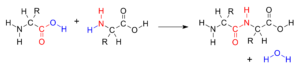
A peptide bond is a covalent bond that is formed between two amino acids when a carboxyl group or C-terminus of one amino acid reacts with the amino group or N-terminus of another amino acid in a condensation reaction (a molecule of water is released during the reaction). The resulting bond is a CO-NH bond and forms a peptide, or amide molecule. Likewise, peptide bonds are amide bonds.
(More information about peptide bonds.)
The word “peptide” itself comes from πέσσειν, the Greek word meaning “to digest.” Peptides are an essential part of nature and biochemistry, and thousands of peptides occur naturally in the human body and in animals. In addition, new peptides are being discovered and synthesized regularly in the laboratory as well. Indeed, this discovery and innovation in the study of peptides holds great promise for the future in the fields of health and pharmaceutical development.
How Are Peptides Formed?
Peptides can be created artificially in a lab or naturally in the body. Certain peptides, including ribosomal and non-ribosomal peptides, are produced organically by the body. Peptide synthesis methods such as liquid phase peptide synthesis and solid phase peptide synthesis can produce an almost infinite number of peptides in the lab. Although there are several benefits to liquid phase peptide synthesis, solid phase peptide synthesis is now the most common method. Learn more about the production of peptides.
The first synthetic peptide was discovered in 1901 by Emil Fischer in collaboration with Ernest Fourneau. Oxytocin, the first polypeptide, was synthesized in 1953 by Vincent du Vigneaud
Peptide Terminology
In general, peptides are categorized based on how many amino acids they contain. A “dipeptide” is the shortest peptide, consisting of only two amino acids. Similarly, a “tripeptide” is a peptide that has three amino acids. Shorter peptides with comparatively few amino acids—typically fewer than ten—are referred to as oligopeptides. On the other hand, polypeptides usually consist of more than ten amino acids. Proteins are typically defined as much bigger peptides (those made up of more than 40–50 amino acids).
While the number of amino acids contained is a main determinate when it comes to differentiating between peptides and proteins, exceptions are sometimes made. For example, certain longer peptides have been considered proteins (like amyloid beta), and certain smaller proteins are referred to as peptides in some cases (such as insulin). For more information about the similarities and differences among peptides and proteins, read our Peptides Vs. Proteins page.
Classification of Peptides
In general, peptides are separated into multiple classes. Depending on how the peptides are made, these classifications differ. For instance, mRNA translation results in the production of ribosomal peptides. In organisms, ribosomal peptides frequently serve as hormones and signaling molecules. Tachykinin peptides, opioid peptides, pancreatic peptides, vasoactive intestinal peptides, and calcitonin peptides are a few examples. Certain species create ribosomal peptides that are antibiotics, such as microcins. To reach the mature form, ribosomal peptides frequently undergo proteolysis, which is the breakdown of proteins into smaller peptides or amino acids.
On the other hand, unlike ribosomal peptides, which are made by the ribosome, nonribosomal peptides are made by peptide-specific enzymes. Although linear nonribosomal peptides can regularly occur, nonribosomal peptides are typically cyclic. Nonribosomal peptides have the ability to form incredibly complex cyclic structures. One-celled creatures, fungi, and plants all commonly contain nonribosomal peptides. The most prevalent nonribosomal peptide is glutathione, which is essential for aerobic species’ antioxidant defenses.
Milk peptides in organisms are formed from milk proteins. They can be produced by enzymatic breakdown by digestive enzymes or by the proteinases formed by lactobacilli during the fermentation of milk. Additionally, peptones are peptides derived from animal milk or meat that have been digested by proteolytic digestion. Peptones are often used in the laboratory as nutrients for growing fungi and bacteria.
Furthermore, peptide fragments are most frequently discovered as the byproducts of enzymatic degradation carried out on a controlled sample in a lab. Peptide fragments, however, can also arise spontaneously due to degradation caused by natural processes.
Important Peptide Terms
A comprehensive grasp of peptides, peptide synthesis, and the application of peptides in research and experimentation requires familiarity with a few fundamental peptide-related terms:
Amino Acids: Amino acids make up peptides. Any molecule with both amine and carboxyl functional groups is an amino acid. The building blocks of peptides are alpha-amino acids.
Cyclic Peptides – A cyclic peptide is a peptide in which the amino acid sequence forms a ring structure instead of a straight chain. Examples of cyclic peptides include melanotan-2 and PT-141 (Bremelanotide).
Peptide Sequence – The peptide sequence is simply the order in which amino acid residues are connected by peptide bonds in the peptide.
Peptide Bond – A peptide bond is a covalent bond that is formed between two amino acids when a carboxyl group of one amino acid reacts with the amino group of another amino acid. This reaction is a condensation reaction (a molecule of water is released during the reaction).
Peptide Mapping – Peptide mapping is a process that can be used to validate or discover the amino acid sequence of specific peptides or proteins. Peptide mapping methods can accomplish this by breaking up the peptide or protein with enzymes and examining the resulting pattern of their amino acid or nucleotide base sequences.
Peptide Mimetics – A peptide mimetic is a molecule that biologically mimics active ligands of hormones, cytokines, enzyme substrates, viruses or other bio-molecules. Peptide mimetics can be natural peptides, a synthetically modified peptide, or any other molecule that performs the aforementioned function.
Peptide Fingerprint: A peptide’s chromatographic pattern is known as a peptide fingerprint. By partially hydrolyzing the peptide, which splits it into fragments, and then 2-D mapping those fragments, a peptide fingerprint is created.
Peptide Library: A peptide library is made up of several peptides with a methodical arrangement of amino acids. The study of proteins for biochemical and medicinal purposes frequently makes use of peptide libraries. The most used method for creating peptide libraries is solid phase peptide synthesis.